As I write this, it is the second week of Advent, so here is an interesting connection I just read about between the Advent hymn O Come, O Come, Emmanuel and the writing of J. R. R. Tolkien. It’s a bit of a journey.
Going back to the 8th century, the Church has sung the “O Antiphons” during Vespers services in the final days of Advent leading up to Christmas. Antiphon means “sung responsively,” and each “O Antiphon” is just a short chant that the congregation historically sang before and after the Magnificat.
They are called “O” Antiphons because they address Christ as “O Something”. They are:
- 17 December: O Sapientia (O Wisdom)
- 18 December: O Adonai
- 19 December: O Radix Jesse (O Root of Jesse)
- 20 December: O Clavis David (O Key of David)
- 21 December: O Oriens (O Dawn of the East)
- 22 December: O Rex Gentium (O King of the Nations)
- 23 December: O Emmanuel
(Reading the first letters of these titles up from the bottom, they form a Latin acrostic, Ero cras, meaning “Tomorrow, I will be [there]” – a fitting theme for Advent!)
I want to point out two works that were derived from these ancient O Antiphons. One is a 10th century Anglo-Saxon poem called Crist, and the other is the hymn O Come, O Come, Emmanuel.
In the 10th century, a poet (traditionally Cynewulf) wrote Crist, an Advent poem based on the O Antiphons. This is part of a larger work known as the Exeter Book, which also includes Crist II (about the Ascension) and Crist III (about the final judgement). Anyway, Crist will come up again in a moment.
Likewise, in the 12th century, the antiphons were paraphrased into the hymn Veni, Veni, Emmanuel. In 1851, this was translated into English by John Mason Neale as the hymn, O Come, O Come, Emmanuel.
So, keeping all that in mind: in the fall of 1914, J. R. R. Tolkien was visiting his aunt at a farmhouse in Gedling, Nottinghamshire. Naturally, he had brought along some ancient Anglo-Saxon poetry to read (this is what people did before TV and smartphones). Sitting in the farmhouse, he came across this line, which gave him “a curious thrill, as if something had stirred in me, half wakened from sleep”:

Reading from the fifth word in that top line, this is:
Eala earendel, engla beorhtast,
ofer middangeard monnum sended
Hail Éarendel, brightest of angels,
Sent to men over middle-earth…
Tolkien wrote, “There was something very remote and strange and beautiful behind those words, if I could grasp it, far beyond ancient English.”
“With hints like these in the back of his mind – though without conscious Christian intent, since it was mainly the sound of the words that enchanted him – Tolkien composed a poem, The Voyage of Éarendel the Evening Star, in which Éarendel steers his ship of burning light across the sky in pursuit of the sun, in endless round, until cold and age end his quest.”
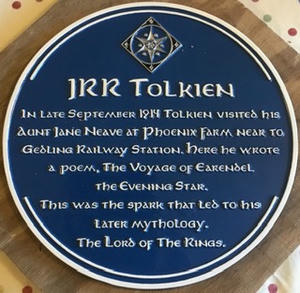
This one line from Crist was the imaginative seed for all of Tolkien’s Middle-Earth myths and stories, including The Lord of the Rings.
So, can we find this line about Éarendel in O Come, O Come, Emmanuel? Indeed we can!
In Old English, Éarendel means something like “radiant morning light,” “dawn-star,” or “shining one.” This passage of Crist is based on the fifth of the O Antiphons, “O Oriens”:
O Oriens, splendor lucis aeternae et sol iustitiae:
O Rising Dawn, brightness of eternal light and sun of justice…
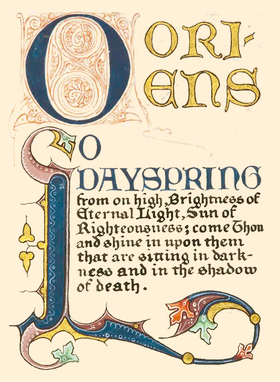
And this “O Oriens” antiphon comes through in verse 3 of O Come, O Come, Emmanuel as:
O come, Thou Dayspring from on high,
And cheer us by Thy drawing nigh;
Disperse the gloomy clouds of night,
And death’s dark shadows put to flight.
Oriens, from the Latin orier, to appear, to arise. The Morning Star, the Dayspring, Éarendel!
In my church, we sing the first verse of O Come, O Come, Emmanuel during the first week of Advent, then we add a verse each Sunday leading up to Christmas. So this coming Sunday, when we sing “O come, Thou Dayspring…”, I’ll be picturing Christ, the dawning light, “sent to men over middle-earth.”
P.S.
- In The Fellowship, the authors ask, “who is Éarendel?” Typically, the “rising sun” is Christ, but there are 10th century homilies which use that term to refer to John the Baptist. He is the “morning star” (i.e., Venus), the forerunner of the dawn. “Tolkien thought he could see, in these associations, the baptized version of an astral myth.”
Not to over-exegete this (not my forte!), but if Éarendel is rightly understood as “rising sun,” I think it only makes sense that the term refers to Christ. See this part of the Song of Zachariah (Luke 1:76-79), in which “rising sun” is clearly refering to Christ:
And you, my child [i.e., John], will be called a prophet of the Most High;
for you will go on before the Lord to prepare the way for him,
to give his people the knowledge of salvation
through the forgiveness of their sins,
because of the tender mercy of our God,
by which the rising sun will come to us from heaven
to shine on those living in darkness
and in the shadow of death,
to guide our feet into the path of peace.
In the KJV, that “rising sun” is “dayspring”!
- The “O Oriens” antiphon is sung on December 21, which is my anniversary! I could take this further and start calling my wife “Elwing” (Earendel’s wife and the mother of Elrond in the Silmarillion – not that I’ve read that, but I Googled it). Not sure that would go over, though…
Notes


